Writing My Life

Now and Then


2 Comments

… my grandmother: a pioneer in her own right …

I was asked to speak in church about pioneers, and the minute I accepted I knew I needed to talk about my mom’s mother – also named Rebecca. As the entire speech is little lengthy for a post, the following is the first part of my talk. I will post the second part as soon as I write it. Yes, I presented a half-written talk. Oh, and heck back because I am going to post photos as well. But not tonight. 

Officially the pioneer era ended with the advent of the transcontinental railroad. No longer did immigrants or other western settlers have to cross the American continent via covered wagons or handcarts. Nevertheless, pioneering and the pioneer spirit lived on. While my family history does include individuals who ventured forth to Zion in prairie schooners, it also consists of grandparents who continued to settle communities beyond the Wasatch front well into the twentieth century. Among those was my grandmother Rebecca Wheelwright Howe.

Little Rebecca Wheelwright

Grandma Howe’s childhood read like Cinderella’s younger years. Like the fairytale heroine, Grandma was born into a loving family where the beautiful young mother died at age 28. My grandmother was one of 6 children, all under the age of 10, who were left motherless. That was a heavy burden for her father Mathew Wheelwright, but somehow he managed to care for them as a single parent until he met and married Amanda, a woman from Sweden. Grandma’s life dramatically changed again.

While Amanda managed the household, she did not extend the loving care and concern to her stepchildren. When she and my great-grandfather had two sons of their own, Grandma and her siblings were not allowed to eat at the same table with the “new” family. Instead they were sent to the kitchen to eat their meals, a simple fare, while those at the table enjoyed three or four courses that included dessert.

Once my grandmother learned her letters and numbers, she was taken out of fourth grade to stay home and help her stepmother with household chores, watching children, feeding chickens, and tending the garden. By age 12 she was hired out to other households to fend for herself and provide added income for her family. One particular employer was especially unkind, and Grandma wished so much that she could return home, even if it meant living under the same roof as her stepmother.

Fredrick James Howe as a baby and a dashing young man

I doubt that my grandmother dreamed a prince or a knight who would sweep in on a mighty charger and rescue her from a life of drudgery, but she did meet the love of her life one spring day while walking down 25th Street in Ogden. My grandfather, whose family accepted the gospel while living in England, immigrated to Utah when he was three.  At age 20 Frederick had developed many skills, and among those, he broke wild horses – more of a cowboy than a prince, I guess. But when he saw Rebecca Wheelwright and she saw Frederick James Howe, sparks flew and they were married not long after meeting on that spring day on 25th Street.

After 8 years of working as a butcher and grocer, Grandpa decided it might be best for their growing family to move north to Idaho. Having visited his parents there and seeing the fields of green

The Traditional Wedding Pose

wheat, he believed he could be successful at dry-farming, and so they packed all their household furniture, a cow, two horses, some chickens, a wagon AND my grandpa into a boxcar and headed north. That must have been such a pleasant journey??!!

Grandma and her 4 little ones followed a week later on the train. The conductor who helped her off asked her, “Where did you have all those kiddies?”

“On one ticket right there in the car,” she replied, and the railroad man enjoyed a good laugh.

Life homesteading the 160 acres in Marsh Center, Idaho was so hard, and they quickly learned why it was called DRY FARMING. They had to haul all the water they used in barrels for two or three miles, and not a drop was wasted. Four more children were born while they labored there, and two were taken away.

To be continued.

Leave a comment

thinking of grandmothers

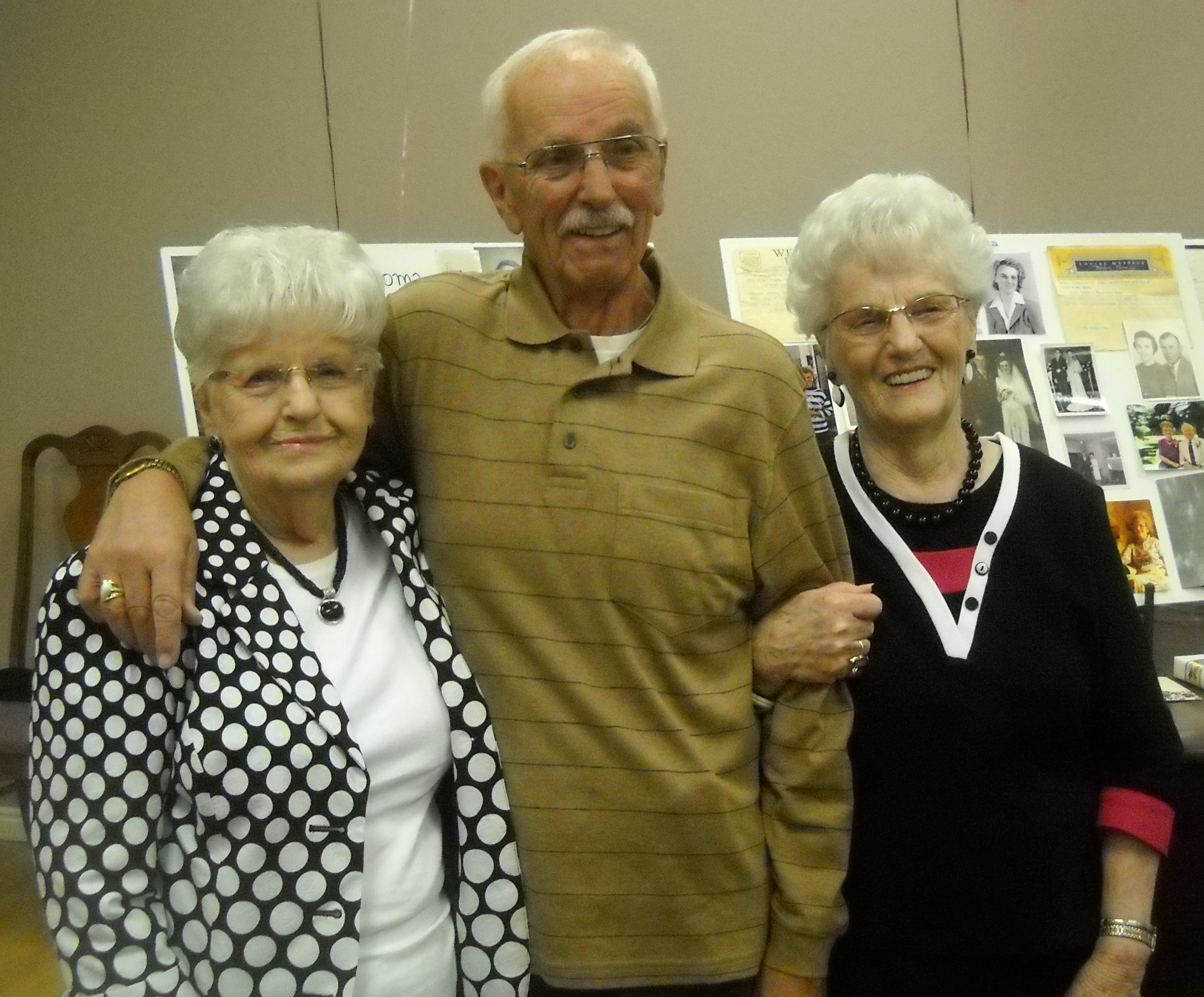
Mom, Uncle Lloyd, and Aunt Wyoma


 Yesterday I took Mom to celebrate my Aunt Wyoma’s 90th birthday. While there, I chatted with Uncle Lloyd. These three are the remaining children of my grandparent’s 9 sons and 4 daughters. Last year, Mom wrote the first installment of her personal history, and so we talked often of her mother and father and her growing-up years in southern Idaho. Their lives were hard, especially in comparison to my own.    

Sometimes I have a difficult time realizing how much has changed in just a couple of generations – more than fashions or hairstyles, homes or cars, technology or pop culture. I’m thinking about my grandmother’s way of life compared to my own. Interestingly, I recently read a paragraph in a novel that lists some housewives’ duties as rendered in 1940. While the plot of Philip Roth’s fiction of alternate history has VERY LITTLE to do with the direction my reverie, I decided the author’s description extends beyond that of a  Jewish  neighborhood in Newark, NJ. I could picture both of my grandmothers performing every listed task plus more in their little Mormon homes in Idaho.        

Roth writes:        

The men worked fifty, sixty, even seventy or more hours a week; the women worked all the time with little assistance from labor-saving devices, washing laundry, ironing shirts, mending socks, turning collars, sewing on buttons, moth-proofing woolens, polishing furniture, sweeping and mopping floors, washing windows, cleaning sinks, tubs, toilets and stoves, vacuuming rugs, nursing the sick, shopping for food, cooking meals, feeding relatives, tidying closets and drawers, overseeing paint jobs and household repairs, arranging for religious observances, paying bills and keeping the family books while simultaneously attending to their children’s health, clothing, cleanliness, schooling, nutrition, conduct, birthdays, discipline and morale.        

As I perused the long list, I pictured how much time women devoted to performing these responsibilities. I do SOME of these things, but modern conveniences have stripped away much of the drudgery.        

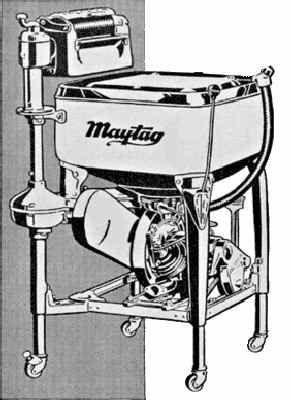
Grandma's was a gray version of this one.


For example, Mom related that for much of her married life,  my grandma heated water for washing clothes on a “boiler” that she placed over two plates on the stove to heat the water. In 1940, Mom’s parents purchased a Maytag washer. I can’t even imagine what a thrill that must have been for her.        

Nevertheless, my grandmothers and my mother hung clothes on lines to dry as did I when I was first married. Dryers weren’t part of their households for a very long time, but I didn’t go without that luxury for more than 5 or 6 years. G.E.’s mom NEVER purchased a dryer. She loved the freshness of hung-dried sheets, towels, shirts, etc. in spite of their starched-like stiffness!        

This Ironrite looks like Grandma Barrett's


In the 1950s, I thought Grandma B. was rich because she owned an Ironrite, an automatic roller iron, also called a Mangle! (What kind of name is that for an appliance that was supposed to make life easier?) I watched her feed sheets, pillowcases, DISHTOWELS, hankies, dresses, blouses, shirts, and slacks between the two giant rollers with a deftness that I admired. I dared not stand too close, however, because I was afraid the monster might grab hold of my little hand and press it flat!        

Additionally, one grandmother served as president of the Relief Society, the women’s auxiliary of our church, for 8 years! My other grandma played the organ for Sunday meetings for many, many years. Grandma H. often assisted Grandpa in hanging wallpaper – one of his many jobs that included carpentry, butchery, dry farming, and mechanics. And Grandma B. organized her children into a family dance band to help bring in extra money.        

Both Rebecca and Ethyl were amazing women that I still adore across the decades and into the eternities. God bless them!   

Note: I’m a fan of The Writer’s Corner (and also what I ate today), written by Ann Cannon, and so I’m sort of taking her lead by adding a “page” to this blog – “and what I read today!” So if you want a little info about what held my interest via hard copy OR audio copy, go HERE to read what I think of The Plot Against America by Philip Roth.